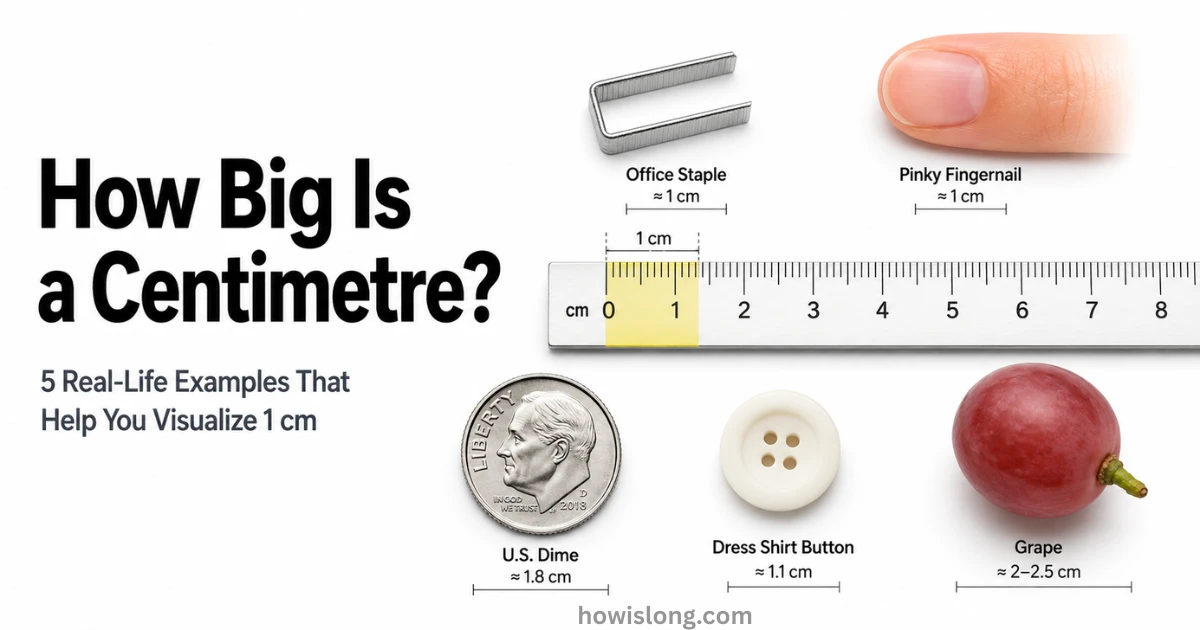
1 centimeter equals 10 millimeters, 0.01 meters, and about 0.39 inches.
It is roughly the width of your pinky fingernail.
Most people in the USA rely on the imperial system every day, which makes picturing a centimeter surprisingly hard without a ruler in hand.
This guide fixes that using five everyday objects you already own or can picture instantly.
How Long Is a Centimeter
A centimeter (cm) is a unit of length in the International System of Units (SI) — the globally accepted version of the metric system.
Think of it simply: 1 centimeter is about the width of a standard adult pinky fingernail. That single reference is used in nursing education, first-aid training, and clinical measurement worldwide because it is always with you and remarkably consistent.
Visually, 1 cm is noticeably smaller than 1 inch, clearly larger than 1 millimeter, and small enough to measure fine detail yet large enough to see with the naked eye without difficulty.
How Many Millimeters in a Centimeter
1 centimeter equals exactly 10 millimeters. This is one of the most foundational relationships in the metric system — and one every student, medical professional, and engineer should know instantly.
A simple way to picture it: a single grain of rice is roughly 1 mm wide. Line up ten grains of rice side by side and you have exactly 1 centimeter.
Formula: Centimeters × 10 = Millimeters
Shortcut: Move the decimal one place to the right.
Worked Example: 3.5 cm × 10 = 35 millimeters
| Millimeters (mm) | Centimeters (cm) |
|---|---|
| 1 mm | 0.1 cm |
| 2 mm | 0.2 cm |
| 3 mm | 0.3 cm |
| 4 mm | 0.4 cm |
| 5 mm | 0.5 cm |
| 6 mm | 0.6 cm |
| 7 mm | 0.7 cm |
| 8 mm | 0.8 cm |
| 9 mm | 0.9 cm |
| 10 mm | 1 cm |
| 11 mm | 1.1 cm |
| 12 mm | 1.2 cm |
| 13 mm | 1.3 cm |
| 14 mm | 1.4 cm |
| 15 mm | 1.5 cm |
| 16 mm | 1.6 cm |
| 17 mm | 1.7 cm |
| 18 mm | 1.8 cm |
| 19 mm | 1.9 cm |
| 20 mm | 2 cm |
| 21 mm | 2.1 cm |
| 22 mm | 2.2 cm |
| 23 mm | 2.3 cm |
| 24 mm | 2.4 cm |
| 25 mm | 2.5 cm |
| 26 mm | 2.6 cm |
| 27 mm | 2.7 cm |
| 28 mm | 2.8 cm |
| 29 mm | 2.9 cm |
| 30 mm | 3 cm |
| 31 mm | 3.1 cm |
| 32 mm | 3.2 cm |
| 33 mm | 3.3 cm |
| 34 mm | 3.4 cm |
| 35 mm | 3.5 cm |
| 36 mm | 3.6 cm |
| 37 mm | 3.7 cm |
| 38 mm | 3.8 cm |
| 39 mm | 3.9 cm |
| 40 mm | 4 cm |
| 41 mm | 4.1 cm |
| 42 mm | 4.2 cm |
| 43 mm | 4.3 cm |
| 44 mm | 4.4 cm |
| 45 mm | 4.5 cm |
| 46 mm | 4.6 cm |
| 47 mm | 4.7 cm |
| 48 mm | 4.8 cm |
| 49 mm | 4.9 cm |
| 50 mm | 5 cm |
How Many Inches in a Centimeter
1 centimeter equals approximately 0.3937 inches. Flipped around, 1 inch equals exactly 2.54 centimeters — a value standardized by the International Yard and Pound Agreement of 1959, which formally defined the international inch in terms of the metric system.
Formula: Centimeters ÷ 2.54 = Inches
Shortcut: Divide any centimeter value by 2.54 to get inches fast.
Worked Example: 10 cm ÷ 2.54 = 3.94 inches
| Centimeters (cm) | Inches (in) |
|---|---|
| 1 cm | 0.39 in |
| 2 cm | 0.79 in |
| 3 cm | 1.18 in |
| 4 cm | 1.57 in |
| 5 cm | 1.97 in |
| 6 cm | 2.36 in |
| 7 cm | 2.76 in |
| 8 cm | 3.15 in |
| 9 cm | 3.54 in |
| 10 cm | 3.94 in |
| 11 cm | 4.33 in |
| 12 cm | 4.72 in |
| 13 cm | 5.12 in |
| 14 cm | 5.51 in |
| 15 cm | 5.91 in |
| 16 cm | 6.30 in |
| 17 cm | 6.69 in |
| 18 cm | 7.09 in |
| 19 cm | 7.48 in |
| 20 cm | 7.87 in |
| 21 cm | 8.27 in |
| 22 cm | 8.66 in |
| 23 cm | 9.06 in |
| 24 cm | 9.45 in |
| 25 cm | 9.84 in |
| 26 cm | 10.24 in |
| 27 cm | 10.63 in |
| 28 cm | 11.02 in |
| 29 cm | 11.42 in |
| 30 cm | 11.81 in |
| 31 cm | 12.20 in |
| 32 cm | 12.60 in |
| 33 cm | 12.99 in |
| 34 cm | 13.39 in |
| 35 cm | 13.78 in |
| 36 cm | 14.17 in |
| 37 cm | 14.57 in |
| 38 cm | 14.96 in |
| 39 cm | 15.35 in |
| 40 cm | 15.75 in |
| 41 cm | 16.14 in |
| 42 cm | 16.54 in |
| 43 cm | 16.93 in |
| 44 cm | 17.32 in |
| 45 cm | 17.72 in |
| 46 cm | 18.11 in |
| 47 cm | 18.50 in |
| 48 cm | 18.90 in |
| 49 cm | 19.29 in |
| 50 cm | 19.69 in |
How Long Is a Centimeter — 5 Real-Life Examples
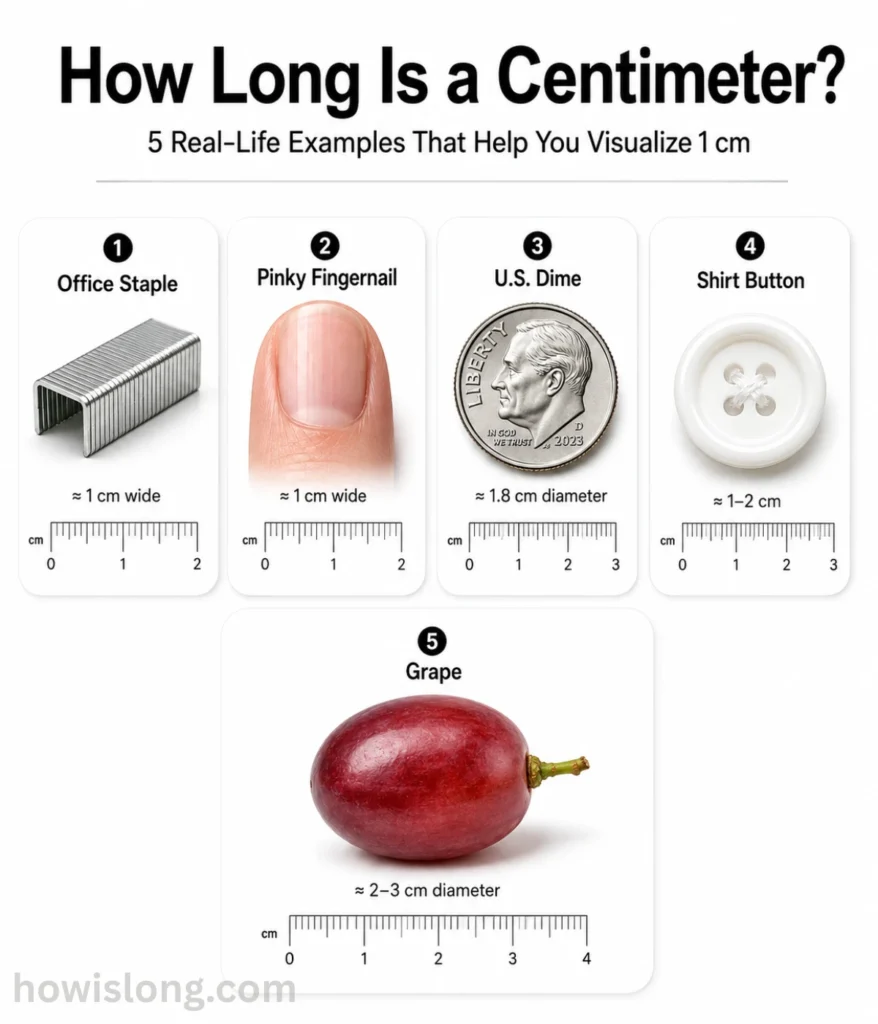
A Standard Staple Is About 1 Centimeter Wide
A regular office staple — the kind loaded into a Swingline or Bostitch stapler — measures almost exactly 1 cm across when closed.
The standard No. 10 staple, the most common size used in American offices, has a closed width that lands right at the 1 centimeter mark.
It is on most desks, in most drawers, and requires zero guesswork. Next time you need a fast mental image of how long 1 cm is, picture the flat closed width of a single staple.
The Width of a Pinky Fingernail Is Roughly 1 Centimeter
The average adult pinky fingernail measures approximately 1 cm in width — a reference actively taught in nursing school curricula and emergency first-aid certification programs across the country.
This technique is called the “body ruler” method. It is used in clinical settings when a formal ruler is unavailable and a quick visual estimate of wound size, skin lesion diameter, or bruise measurement is needed.
A U.S. Dime Measures About 1.8 Centimeters in Diameter
The United States dime, produced by the U.S. Mint, has a federally standardized diameter of 17.91 mm — just under 1.8 centimeters.
Because its dimensions are regulated under the Coinage Act and maintained by the Bureau of the Mint, it is one of the most dimensionally reliable objects in everyday American life.
For anyone building a working sense of centimeter scale, the U.S. dime is the most trustworthy coin-based measuring reference available in the USA.
A Shirt Button Ranges From 1 to 2 Centimeters
A standard dress shirt button ranges from 1 cm to 2 cm in diameter, depending on where it sits on the garment. Collar buttons and cuff buttons sit at the smaller end of that range, while mid-placket buttons land closer to the 1.5 cm mark.
Tailors, seamstresses, and garment manufacturers work in centimeters by default — the metric system is the standard across the global textile and apparel industry.
The shirt button is one of the most tactile and relatable centimeter references for anyone working in sewing, fashion design, or clothing alterations.
A Grape Is Approximately 2 to 3 Centimeters in Diameter
A standard table grape — whether a Thompson Seedless, Red Globe, or Concord variety — typically measures between 2 cm and 3 cm in diameter at its widest point.
This is exactly why oncologists, radiologists, and primary care physicians describe masses, lymph nodes, and cysts as “the size of a grape.”
It maps directly to the 2–3 cm measurement range in a way patients immediately understand. The American Cancer Society uses fruit-based size comparisons because they translate clinical metric measurements into real human experience.
FAQs About How Big Is a Centimeter
How big is a centimeter?
1 centimeter equals 10 millimeters, 0.01 meters, and 0.39 inches — roughly the width of an adult pinky fingernail.
How many millimeters in a centimeter?
There are exactly 10 millimeters in 1 centimeter. Multiply any centimeter value by 10 to convert instantly to millimeters.
How many inches in a centimeter?
1 centimeter equals approximately 0.39 inches. Conversely, 1 inch equals exactly 2.54 centimeters.
How long is a centimeter?
A centimeter is roughly as long as the closed width of a standard office staple — one of the most precise and consistent everyday 1 cm references available.
How much is a centimeter?
One centimeter is one-hundredth of a meter — a compact, precise unit used across medicine, science, engineering, and everyday measurement globally.
Conclusion
Now you have five concrete, reliable references for understanding how big a centimeter is — from the U.S. dime in your pocket to the grape on your plate.
Whether you are working in healthcare, construction, fashion, or simply making sense of a metric measurement, these everyday objects give you instant, accurate centimeter visualization without any tools. Keep these references in mind and you will never have to guess at a centimeter again.

Hi, I’m Ava Addams, the author at HowIsLong.com. I help simplify measurements with easy-to-use tools and clear explanations—so you can convert units quickly and accurately.Explore our guides to understand lengths, distances, and everyday measurements with confidence.