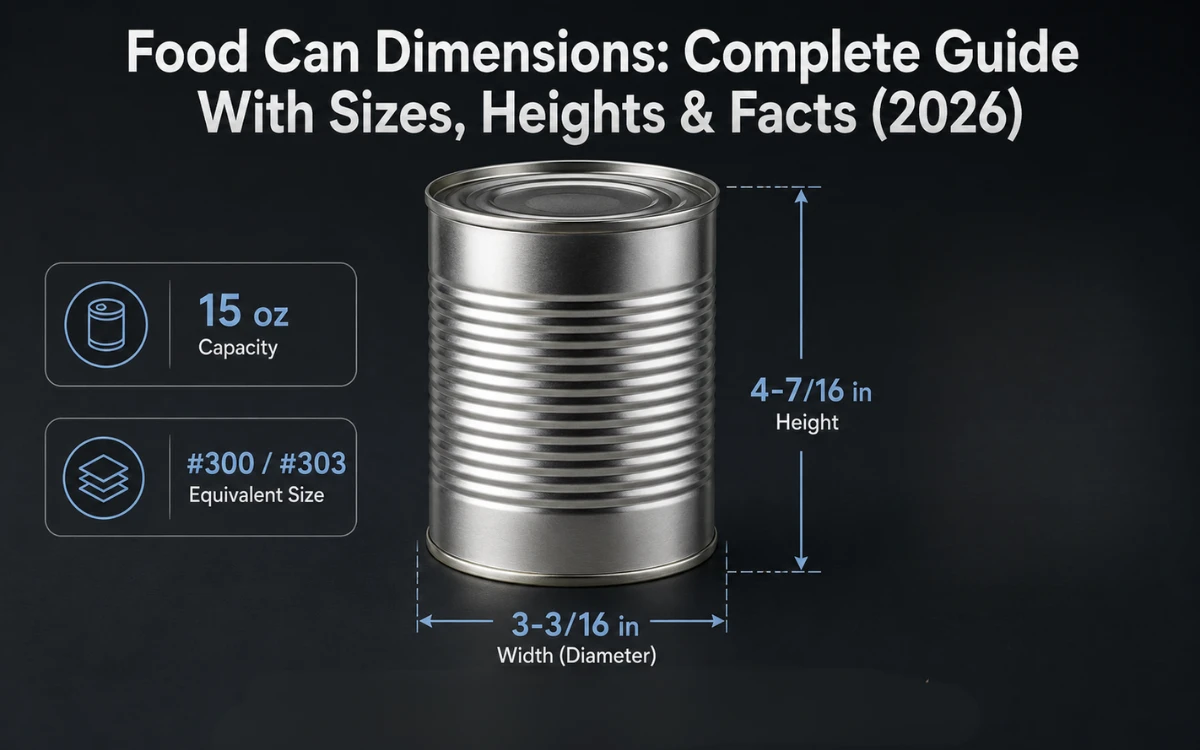
A standard food can in the USA typically ranges from 2-1/8 inches to 6-3/16 inches in diameter and 2-1/4 inches to 7 inches in height, depending on the size code.
The most common everyday size is the 15 oz (#300/#303 equivalent) can, which measures about 3-3/16 inches wide and 4-7/16 inches tall.
This guide covers every common can size — from the tiny 5 oz tuna can to the massive #10 foodservice can. You will find exact height, diameter, and volume for each size, plus things most guides skip entirely.
Standard Household Food Can Sizes & Dimensions
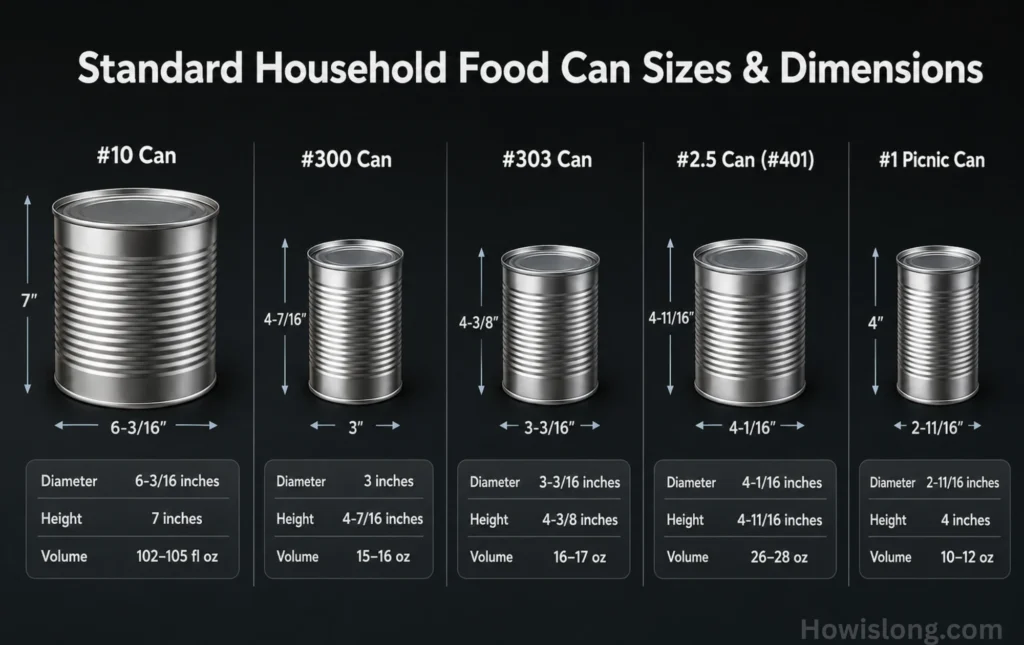
Everyday retail food cans come in multiple sizes designed for pantry storage, meal preparation, labeling efficiency, and convenient household use.
#10 Can Dimensions
The #10 can is the largest standard size. Diameter: 6-3/16 inches. Height: 7 inches. It holds 102 to 105 fluid ounces — roughly 13 cups.
Restaurants, schools, and hospitals use it daily. According to packaging industry data, #10 cans account for nearly 30% of all foodservice packaging in the USA. One can feeds a large group in a single meal prep.
#300 Can Dimensions
Diameter: 3 inches. Height: 4-7/16 inches. Holds 15 to 16 ounces.
This is a common pantry staple. Industry data shows the #300 size appears in over 50% of canned vegetable sales across American retail stores. It fits easily in standard kitchen cabinets.
#303 Can Dimensions
Diameter: 3-3/16 inches. Height: 4-3/8 inches. Holds 16 to 17 ounces.
Slightly wider than the #300. This is a top retail pick for stewed tomatoes, canned fruit, and beans. The extra width adds more space per can. Most recipes that say “one can” are referring to this size or the 15 oz equivalent.
#2.5 Can Dimensions (#401)
Diameter: 4-1/16 inches. Height: 4-11/16 inches. Holds 26 to 28 ounces.
This is the go-to family-size can. It bridges the gap between everyday retail cans and large commercial sizes. Bakeries use it for pie fillings. Home cooks use it for big-batch soups and stews.
#1 Picnic Can Dimensions
Diameter: 2-11/16 inches. Height: 4 inches. Holds 10 to 12 ounces.
The #1 Picnic is one of the most common small can sizes in American pantries. You will find condensed soups and single-serve fruits in this format. Its narrow profile fits crowded shelves well.
More Posts:Wheelchair Dimensions: Complete Size & Measurement Guide (2026)
Common Grocery Store Food Can Dimensions

From beans and soups to tomatoes and tuna, standard grocery store food cans follow specific dimensions that improve shelf organization, packaging consistency, and kitchen storage compatibility.
12 oz Can Dimensions
Diameter: 2-11/16 inches. Height: 4-13/16 inches. Holds 12 ounces.
This is the standard soda can size and also used for tuna. The tall, narrow shape is one of the most recognized canned food dimensions in the USA.
15 oz Can Dimensions
Diameter: 3-3/16 inches. Height: 4-7/16 inches. Holds 15 ounces.
This is the most common size you grab off a grocery shelf. Beans, corn, diced tomatoes — all come in this format. When a recipe says “one can of beans,” this is it.
How tall is a can of beans? A standard 15 oz can of beans stands 4-7/16 inches tall with a diameter of 3-3/16 inches.
16 oz Can Dimensions
Diameter: 3-3/16 inches. Height: 4-13/16 inches. Holds 16 ounces.
Same width as the 15 oz can but slightly taller. Used for corn, tomatoes, and certain soups. The difference in height is just 3/8 of an inch — easy to mix up on a shelf.
28 oz Can Dimensions
Diameter: 4-1/16 inches. Height: 4-11/16 inches. Holds 28 ounces.
This matches the #2.5 can specs exactly. Crushed tomatoes, whole peeled tomatoes, and pumpkin puree are the most common products in this size.
5 oz & 8 oz Specialty Can Dimensions
5 oz can: Diameter 2-1/8 inches, Height 2-1/4 inches.
8 oz can: Diameter 2-11/16 inches, Height 3 inches.
These smaller sizes fill niche uses. The 5 oz can is standard for tuna and sardines. The 8 oz can works well for tomato sauce and single-serving soups. Both fit easily into compact storage spaces and lunchboxes.
This chart is based on Can Manufacturers Institute (CMI) guidelines. These sizes cover over 95% of all canned goods sold in the USA.
Two-Piece vs. Three-Piece Can Construction
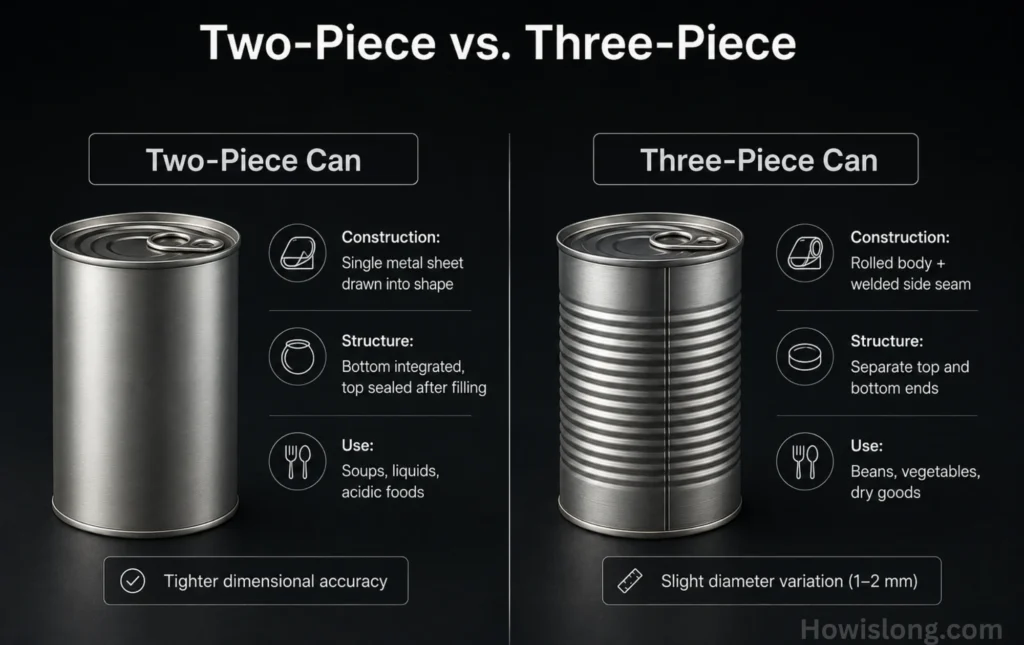
This is something most guides skip entirely — and it directly affects actual food can dimensions.
Two-Piece Can Design & Dimensions
A two-piece can is formed from a single metal sheet drawn into a cup. The bottom is built in. Only the top lid gets added after filling.
This creates a seamless cylinder with no side joint. Two-piece cans maintain tighter dimensional tolerances — often within 0.5mm of the stated size. They resist internal pressure well, making them ideal for liquids, soups, and acidic foods.
Soup can dimensions often use two-piece construction for this exact reason. A standard soup can size like the #300 or #303 benefits from the seamless body because tomato-based products are highly acidic.
Three-Piece Can Design & Dimensions
Three-piece cans use a flat sheet rolled into a cylinder, plus two separate ends — top and bottom. The side gets welded or bonded into a seam.
This method allows for more size flexibility. Most canned vegetables, beans, and dry goods use this construction. The side seam may add 1 to 2mm of variation in diameter measurements.
How Construction Affects Actual Measurements
Two-piece cans hold tighter to their stated diameter and height specs. Three-piece cans can vary slightly at the seam area.
Height stays more consistent across both types because the ends determine it. For buyers and storage planners, this matters when ordering shelving or custom labels. Always measure a physical sample rather than relying only on the code.
More Posts:Kitchen Trash Can Dimensions: Size, Height & Capacity (2026)
How to Read Can Size Codes & Measure a Food Can Yourself
Decoding the Three-Digit Can Code System
The three-digit code on cans like “303” or “401” is not random. It is a direct measurement system.
The first digit = inches. The last two digits = sixteenths of an inch.
So a 303 can means 3 inches + 3/16 inch = 3-3/16 inches in diameter.
A height code of 407 means 4 inches + 7/16 inch = 4-7/16 inches.
This system has been used by the U.S. canning industry for over 100 years.
How to Measure Diameter, Height & Volume at Home
Grab a ruler or a digital caliper. Measure the diameter across the lid — skip the seam ridge because it reads wider.
For height, go from the flat base to the top edge of the lid. This gives you the true can height used in industry specs.
Accuracy to 1/16 inch matters for precision work like custom labels or tight shelf fits. A digital caliper gives cleaner results than a standard ruler.
How big is a can of soup? A typical soup can — the #300 size — measures 3 inches wide and 4-7/16 inches tall. The dimensions of a soup can match the standard #300 or #303 codes in most USA grocery stores.
How tall is a can of soup? Most standard soup cans stand between 4-3/8 and 4-7/16 inches tall depending on the exact size code.
Volume vs. Weight — What the Label Actually Means
This confuses a lot of buyers. Ounces on a food can label mean weight — not liquid volume.
A 15 oz can holds 15 ounces of food by weight. But the actual fluid volume inside may be closer to 13 to 14 fluid ounces depending on the product density.
The USDA requires labels to show net weight — meaning the total weight of everything inside including liquid. Drained weight is the weight of just the solid food after you pour off the liquid.
Headspace — the small gap at the top of every can — is intentional. It allows for thermal expansion during the heating and sealing process. The Can Manufacturers Institute standards require specific headspace levels for food safety.
Always check both net weight and drained weight when scaling recipes or calculating nutritional data.
FAQ’s About Food Can Dimensions
What are standard food can sizes?
Standard sizes in the USA include the #10, #300, #303, #2.5, #1 Picnic, 12 oz, 15 oz, 16 oz, and 28 oz. These cover nearly every retail and commercial use case.
What are the dimensions of a 15 oz can?
A 15 oz can measures 3-3/16 inches in diameter and 4-7/16 inches in height. It is the most common single-serving size in American grocery stores.
What are the dimensions of a regular 12 oz can?
A standard 12 oz can measures 2-11/16 inches in diameter and 4-13/16 inches in height. This size is used for tuna and beverages.
How big is a 28 oz can?
A 28 oz can measures 4-1/16 inches in diameter and 4-11/16 inches tall. It matches the #2.5 industry code and is common for crushed tomatoes and pie fillings.
What are the dimensions of a 16 oz can?
A 16 oz can is 3-3/16 inches wide and 4-13/16 inches tall — slightly taller than the 15 oz but same diameter.
What is a #10 can size?
The #10 can measures 6-3/16 inches in diameter and 7 inches tall. It holds roughly 13 cups of food and is the standard bulk size for restaurants and institutions.
Why is it called a #10 can?
The name comes from the original industry numbering system — not from its size or ounces. It is the tenth classification in the historical U.S. canning size system, developed over 100 years ago.
What is the most common food can size?
The 15 oz can (also coded as #303) is the most common size in American retail stores. Almost every major food brand sells beans, tomatoes, and vegetables in this format.
How do I convert can inches to millimeters?
Multiply any inch measurement by 25.4 to get millimeters. A 3-inch diameter becomes 76.2mm. A 4-7/16 inch height becomes 113mm. This is useful when comparing USA cans to international metric-based sizes.

Hi, I’m Ava Addams, the author at HowIsLong.com. I help simplify measurements with easy-to-use tools and clear explanations—so you can convert units quickly and accurately.Explore our guides to understand lengths, distances, and everyday measurements with confidence.