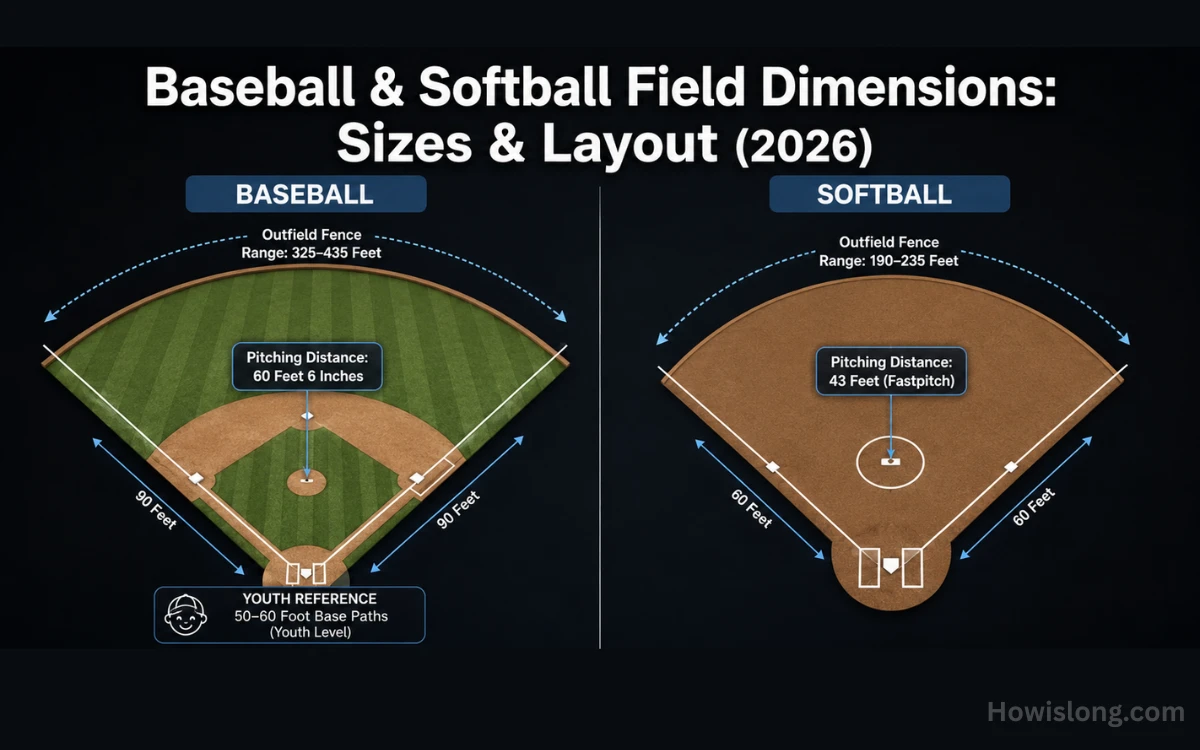
Baseball field dimensions vary by level, but standard adult fields use a 90-foot diamond with a pitching distance of 60 feet 6 inches and outfield fences typically ranging from 325 to 435 feet, while youth baseball fields start around 50 to 60-foot base paths.
Softball fields are more compact, using a 60-foot diamond with a 43-foot pitching distance in fastpitch and outfield fences generally between 190 and 235 feet.
Whether you’re building a new field, managing a facility, or coaching a team — getting these measurements right is non-negotiable.
Standard Baseball Field Dimensions by Age Group & League
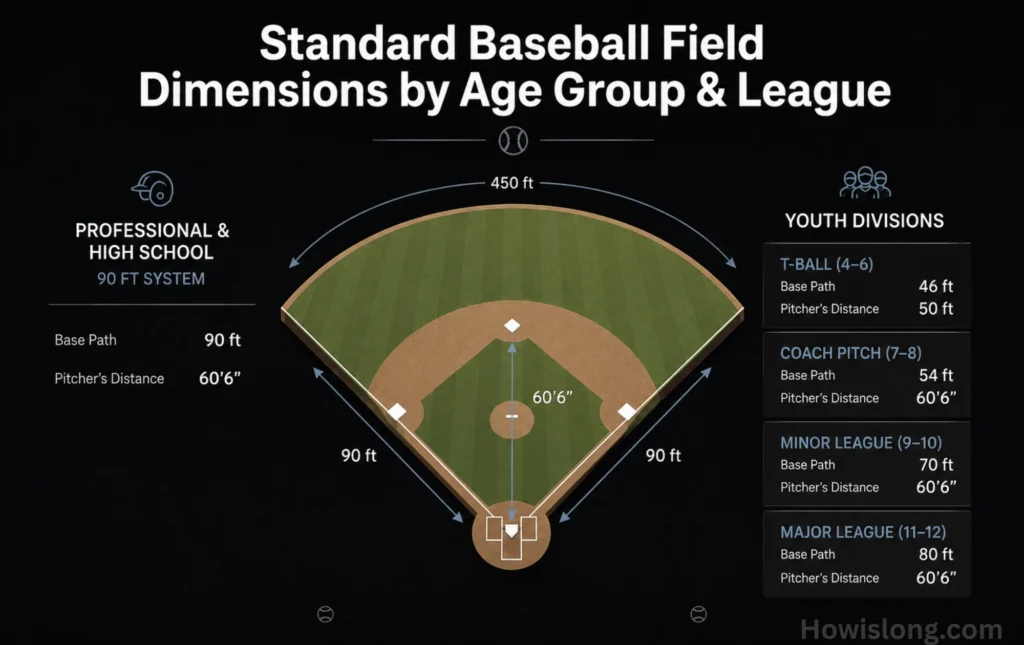
Baseball field size is not one-size-fits-all. Every age group plays on a different diamond.
Professional & High School Baseball (90-Foot Diamond)
Major League Baseball uses 90-foot base paths measured from the back tip of home plate to the back corner of first and third bases. The pitching distance sits at exactly 60 feet 6 inches from the pitcher’s rubber to home plate.
The pitcher’s mound stands 10 inches high inside an 18-foot diameter circle. High school baseball follows these same infield specifications. Outfield fences in MLB parks range from 325 feet down the lines to 435 feet in deep center, though every ballpark varies.
The home plate to backstop distance in professional stadiums often exceeds 60 feet, protecting both catchers and spectators from foul tips.
Youth Baseball Dimensions (Little League to Pony League)
Little League baseball scales everything down for younger athletes. Players aged 9–12 compete on 60-foot base paths with a 46-foot pitching distance. This reduces arm strain and builds proper throwing mechanics safely.
The Intermediate (50/70) division for ages 11–13 uses 70-foot bases and a 50-foot pitching distance — a smart bridge between youth and full-size play.
Pony League moves ages 13–14 onto 80-foot diamonds with a 54-foot pitching distance. By ages 15–18, players graduate to full 90-foot regulation diamonds with standard 60’6″ pitching, matching high school specifications completely.
Why the Pitching Distance Is 60 Feet 6 Inches
This is one of baseball’s most fascinating historical accidents. Before 1893, pitchers threw from just 50 feet away from home plate.
During the re-measurement, a surveyor’s notation reading “60-0” was misread as “60 feet 6 inches” instead of exactly 60 feet. That clerical error became permanent. The distance proved so effective at balancing pitcher velocity against batter reaction time that no governing body has changed it since — over 130 years later.
Softball Field Dimensions & Layout Specifications
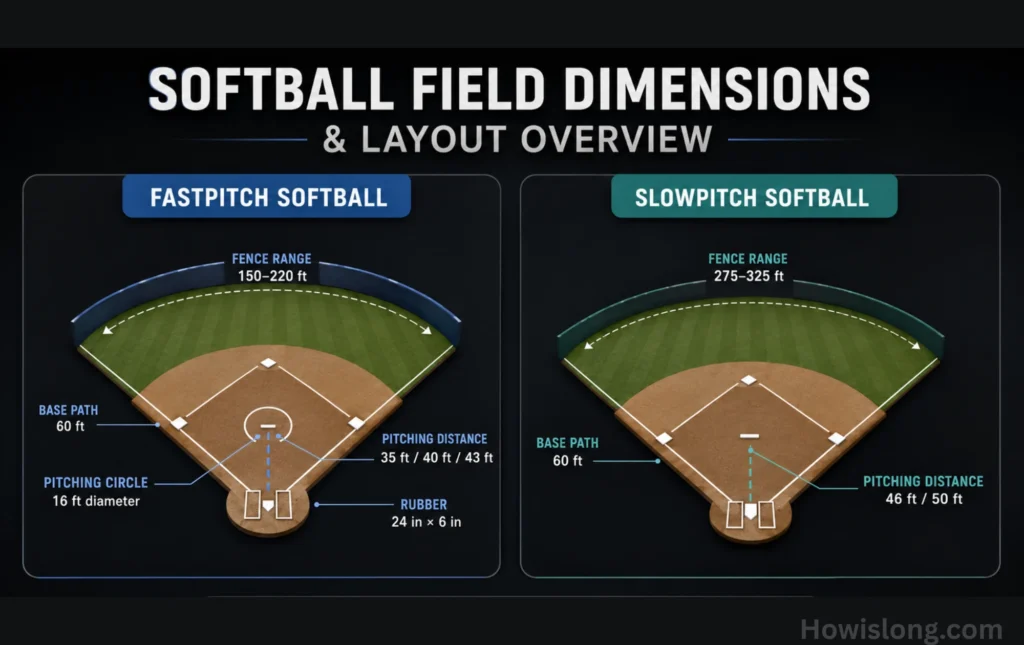
Softball field dimensions operate on a completely different scale than baseball. The smaller diamond, flat pitching circle, and closer fences create a faster, more compressed style of play.
Fastpitch Softball Measurements (Youth, High School & College)
Women’s fastpitch softball uses 60-foot base paths at every competitive level. The standard pitching distance is 43 feet from the front edge of the pitching rubber to the back tip of home plate — used in college, Olympic, and adult competition worldwide.
Youth fastpitch scales the pitching distance down by age:
A key structural difference: fastpitch softball has no elevated mound. Pitchers throw from a flat pitching circle measuring 16 feet in diameter. The pitching rubber itself measures 24 inches long by 6 inches wide, identical in size to baseball’s rubber.
Slowpitch Softball Standards & Co-Ed League Variations
Men’s slowpitch softball maintains the same 60-foot base paths as fastpitch but pushes the pitching distance out to 50 feet. The extra distance accommodates the high arc required by regulation slowpitch delivery rules.
Co-ed recreational leagues often run modified setups. Many facilities set pitching at 46 feet for female pitchers and 50 feet for male pitchers on the same field. This creates competitive balance across different throwing styles without redesigning the entire diamond.
Slowpitch outfield fences sit significantly deeper. Men’s leagues require 275–300-foot minimums, with many competitive tournament fields stretching to 325 feet to control offensive output from the slower, high-arc pitching style.
Outfield Fence Distance Requirements by Level
Outfield fence placement is one of the most misunderstood specifications in field construction. Here’s what each level requires:
These distances are not arbitrary. They balance offensive opportunity against defensive fairness at each level of athletic development.
More Posts:Food Can Dimensions: Complete Guide With Sizes, Heights & Facts (2026)
Baseball vs Softball Field Size — Key Dimensional Differences
Understanding the gap between these two sports helps coaches, architects, and facility managers make smarter decisions — especially when building dual-use spaces.
Why Softball Uses Smaller Dimensions Than Baseball
Softball originated in 1887 as an indoor variant of baseball, designed specifically for gymnasium play. The original ball was larger — 12 inches in circumference versus baseball’s 9–9.25 inches — and traveled slower off the bat.
Those slower ball speeds and the underhand pitching motion required shorter distances to create competitive balance. If softball used 90-foot base paths, the underhand delivery from 43 feet would give pitchers an impossible advantage. The compressed diamond compensates for that mechanical difference.
Dual-Purpose Field Conversions & Practical Challenges
Many parks try to serve both sports on a single field. Converting between baseball and softball requires removable pitching rubbers and adjustable base anchors.
The biggest obstacle is the outfield fence location. A fence built at 200 feet for softball is completely inadequate for regulation high school baseball, which requires 300–325 feet minimum. Permanent fences essentially lock a field into one sport.
Baseball mounds create another problem. Building and then demolishing an elevated mound between seasons causes significant maintenance costs and surface inconsistency. Most dual-use facilities install portable mounds for baseball and use the flat circle for softball.
Critical Field Layout Components & Measurement
These are the specs that many builders and coaches overlook — but they matter just as much as base path distances.
Home Plate, Batter’s Box & Base Positioning Specs
Home plate measures 17 inches across the front edge, with 8.5-inch sides and a pointed rear extending 12 inches. That rear tip is the starting point for every field measurement. All base path distances originate from this exact point.
Batter’s boxes sit 6 inches away from home plate edges, measuring 4 feet wide by 6 feet long. Left and right boxes mirror each other on opposite sides.
Second base positioning is where many amateur field builders make errors. In baseball, the center of second base must sit 127 feet 3⅜ inches from home plate’s rear tip. In softball, that diagonal measures 84 feet 10¼ inches. These are precise geometric calculations, not approximations.
Pitcher’s Mound vs Pitcher’s Circle Construction
Baseball mounds require serious construction. The 18-foot diameter circle must reach exactly 10 inches of elevation at the pitching rubber. The slope begins dropping 6 inches in front of the rubber, descending gradually toward the infield.
Proper mound drainage is essential. Without hidden drainage channels beneath the clay surface, water accumulates and degrades the mound rapidly. Professional facilities install subsurface drainage systems specifically for this reason.
Softball pitching circles are structurally simpler — completely flat, 16 feet in diameter, at ground level. But the surface material still matters. The circle is typically packed clay or turf, clearly marked to indicate the 8-foot radius boundary pitchers must work within.
Warning Tracks, Backstop & Safety Distance Standards
Warning tracks must extend at least 15 feet from outfield fences. The different surface texture — typically crushed brick, cinders, or decomposed granite — alerts outfielders through foot feel before they collide with the wall. Inconsistent warning track widths create dangerous situations during high-speed pursuit plays.
Backstop height should reach a minimum of 20–30 feet to protect spectators from foul balls and wild pitches. Many modern facilities extend protective netting along both foul lines as well, adding an extra layer of spectator safety.
Backstop distance behind home plate ranges from: Youth leagues: 25-foot minimum High school: 40–50 feet Professional ballparks: 60+ feet
Frequently Asked Questions
Are all bases 90 feet apart in baseball?
No. Base path distances change by age group. Youth baseball starts at 50–60 feet, moves to 70–80 feet at intermediate levels, and reaches the standard 90 feet only at high school age and above. Softball uses 60-foot base paths across nearly all competitive levels.
How big is a standard softball field compared to a baseball field?
Baseball fields are significantly larger. Baseball uses 90-foot base paths versus softball’s 60 feet, making the baseball infield roughly 2.25 times bigger in area. Baseball outfield fences extend 325–400+ feet while softball fences range from 190–275 feet depending on the format.
What is the minimum outfield fence distance for softball?
Minimum distances depend on league level. Youth softball (10U) requires at least 150–175 feet. High school fastpitch sets the minimum at 190 feet. College fields must reach at least 190–235 feet. Men’s slowpitch leagues require 275 feet minimum due to higher offensive output.
Why is baseball pitching distance 60 feet 6 inches?
The 60’6″ distance resulted from an 1893 surveying error. When officials moved the pitcher’s rubber back from 50 feet, a notation reading “60-0” was misread as “60 feet 6 inches.” The distance proved so effective at balancing pitching and hitting that it became a permanent standard — unchanged for over 130 years.
What are the base path distances for youth softball?
Youth softball uses 60-foot base paths at every age level, from 10U through adult leagues. What changes is the pitching distance — starting at 35 feet for 10U, moving to 40 feet for 12U, and reaching the adult standard of 43 feet by age 14.
Is 400 feet considered a long home run in baseball?
Yes. MLB data shows only 15–20% of all home runs travel 400 feet or more. That distance represents genuine above-average power. Anything beyond 450 feet is considered elite “tape measure” territory. Most average MLB home runs land between 370–395 feet in real-world tracking data.

Hi, I’m Ava Addams, the author at HowIsLong.com. I help simplify measurements with easy-to-use tools and clear explanations—so you can convert units quickly and accurately.Explore our guides to understand lengths, distances, and everyday measurements with confidence.
Related Posts