Most people use liquids every day but never stop to picture how small 1 ml really is. This guide breaks down six familiar things that measure close to 1 milliliter, so the number finally makes sense. You’ll also get quick conversions to help you visualize this tiny unit in seconds.
| Measurement Unit | 1 Milliliter Equals |
|---|---|
| Liters (L) | 0.001 L |
| Cubic Centimeters (cm³) | 1 cm³ |
| Cubic Meters (m³) | 0.000001 m³ |
| US Fluid Ounces (fl oz) | 0.0338 fl oz |
| US Cups | 0.00423 cups |
| US Pints | 0.00211 pints |
| US Gallons | 0.000264 gallons |
Quick Reference: Things Close to 1 ml
| Object / Example | Approx. Volume (in ml) | Closeness to 1 ml | Best Situation |
|---|---|---|---|
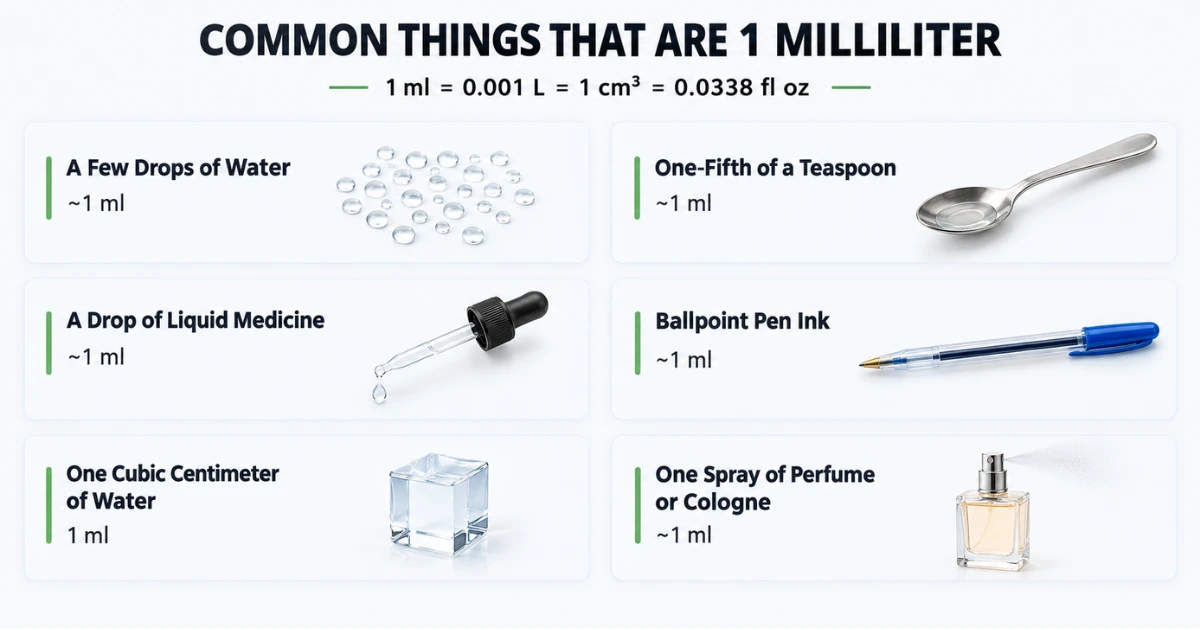
| A Few Drops of Water (~20 Drops) | ~1 ml | 10 / 10 | Quick liquid volume reference |
| One-Fifth of a Teaspoon | ~1 ml | 10 / 10 | Kitchen measurement reference |
| A Drop of Liquid Medicine from a Dropper | ~1 ml | 10 / 10 | Small-dose volume comparison |
| The Ink Inside a Standard Ballpoint Pen | ~1 ml | 10 / 10 | Everyday object volume reference |
| One Cubic Centimeter (1 cm³) of Water | 1 ml | 10 / 10 | Precise scientific reference |
| A Small Splash of Perfume or Cologne from One Spray | ~1 ml | 9 / 10 | Fragrance volume comparison |
More Posts:6 Common Things That Hold 1 Liter of Volume or Capacity
A Few Drops of Water (~20 Drops)
Water drops are the easiest way to picture how much is 1 ml without any tools. About 20 drops from a standard dropper add up to roughly 1 milliliter of liquid.
This comparison works because water drops form at a fairly predictable size due to surface tension. Next time you see a dropper bottle, count 20 drops and you’ve basically measured 1 ml.
One-Fifth of a Teaspoon
A US teaspoon holds close to 4.93 ml, which means 1 ml is just a small sliver of that spoon. This fraction shows up constantly in cooking, baking, and liquid medicine labels.
Picture filling a teaspoon only one-fifth of the way — that thin layer of liquid is your 1 milliliter. It’s a helpful mental image for anyone measuring small liquid doses at home.
A Drop of Liquid Medicine from a Dropper
Liquid medications like infant Tylenol or allergy drops often use droppers calibrated in small ml increments. A single full squeeze from many droppers releases somewhere close to 1 ml.
This is why pediatric dosing charts frequently reference 1 ml or fractions of it. Getting this measurement right matters, since even small liquid medicine doses are calculated precisely by weight and age.
The Ink Inside a Standard Ballpoint Pen
A typical Bic Cristal ballpoint pen holds roughly 1 ml of ink inside its plastic tube. A Paper Mate InkJoy pen carries a similar small ink volume, close to 1 ml as well.
This tiny ink reservoir is enough to write thousands of words before running dry. It’s a surprising but accurate way to visualize just how little liquid 1 ml actually represents.
One Cubic Centimeter (1 cm³) of Water
In the metric system, 1 ml and 1 cubic centimeter (cm³) are exactly the same volume. This equivalence is why medical syringes are often labeled in “cc” instead of “ml.”
Picture a small cube measuring 1 centimeter on each side — that tiny cube holds exactly 1 milliliter of water. This is one of the most scientifically precise ways to define the unit.
A Small Splash of Perfume or Cologne from One Spray
A single spray from a fragrance bottle, like Chanel No. 5 or Dolce & Gabbana Light Blue, typically releases around 1 ml of liquid. This small burst is enough to coat skin with a noticeable scent.
Perfume bottles are often measured in milliliters precisely because the amounts used per spray are so small. Understanding 1 ml helps explain why a 50 ml bottle can last through hundreds of sprays.
More Posts:How Heavy 1 ton ? Everyday Objects With Pictures
Conclusion
1 ml may seem tiny, but it shows up everywhere — from medicine droppers to perfume bottles. Comparing it to drops, teaspoons, and everyday objects makes the measurement instantly easier to grasp. Next time you spot “ml” on a label, you’ll know exactly how much liquid that really means.
FAQ’s
What is 1 ml?
1 ml is a metric unit of volume equal to one-thousandth of a liter, used for measuring small liquid amounts.
How much is 1 ml?
It’s about 20 drops of water, or roughly one-fifth of a teaspoon in everyday terms.
How many units in 1 ml?
1 ml equals 1,000 microliters, making it a mid-sized unit within the metric volume system.
How many units is 1 ml?
In metric terms, 1 ml equals 1 cubic centimeter and 0.001 liters exactly.
1 ml to mg — how much is that?
For water, 1 ml to mg converts to about 1,000 milligrams, based on water’s density.
1 ml to l — what’s the conversion?
1 ml to l equals 0.001 liters, since 1,000 ml make up one full liter.
1 ml to oz — how much is it?
1 ml to oz equals about 0.034 fluid ounces, a very small fraction of a US ounce.

Hi, I’m Ava Addams, the author at HowIsLong.com. I help simplify measurements with easy-to-use tools and clear explanations—so you can convert units quickly and accurately.Explore our guides to understand lengths, distances, and everyday measurements with confidence.