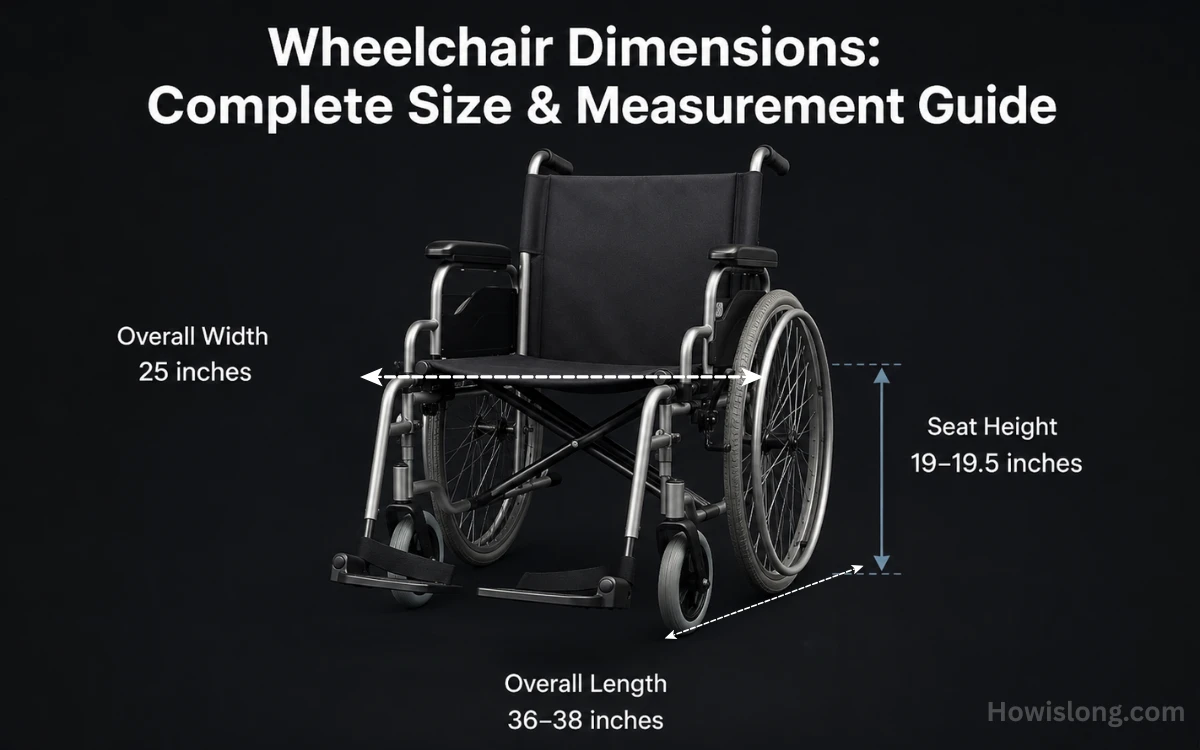
Standard wheelchair dimensions measure 25 inches wide and 36 to 38 inches long for most adult models.
The seat height sits around 19 to 19.5 inches from the floor, which directly affects comfort, doorway clearance, and daily mobility.
Getting the right wheelchair size is not just about fitting through a door. It protects your skin, supports your posture, and makes every single day easier.
Standard Wheelchair Dimensions and Measurements
Overall Width, Length, and Height
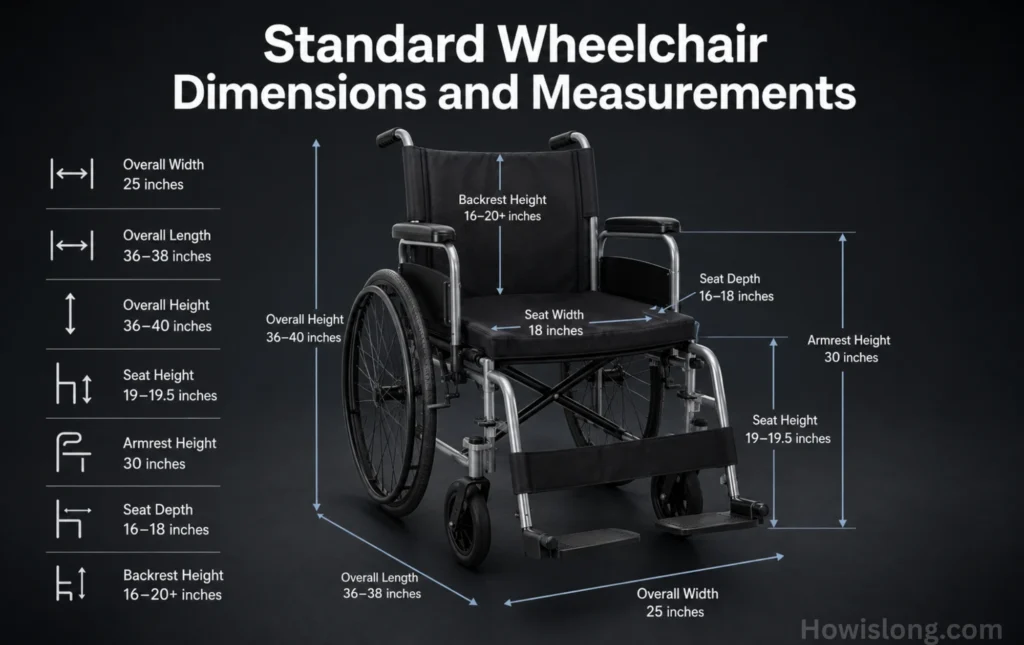
How wide is a standard wheelchair? A standard adult wheelchair measures 25 inches in overall width. This includes the wheels and frame — not just the seat.
The overall length runs about 36 to 38 inches, depending on wheel size. Transit models with smaller rear wheels sit closer to 36 inches. Self-propelled chairs with 24-inch rear wheels reach around 38 inches.
Overall height measures from the ground to the push handles — typically 36 to 40 inches. This height lets caregivers push comfortably without hunching over.
Seat Width, Depth, and Height Standards
Seat width is the measurement most people get wrong. The standard seat width is 18 inches, which fits most average-sized adults. Narrower 16-inch seats suit smaller frames. Wider 20-inch seats work for larger users.
Seat depth runs from the backrest to the front edge. The standard is 16 to 18 inches, with 18 inches being the most common. Taller users with longer thighs often need 20-inch depth.
Seat height sits at 19 to 19.5 inches off the floor. Hemi-height or low-rider models drop to about 17.5 to 18 inches, which allows shorter users to push themselves with their feet touching the ground.
Armrest and Backrest Height Requirements
Armrest height should sit about 1 inch above your elbow when your arms rest at a 90-degree angle. This prevents shoulder pain and keeps your posture aligned. Standard armrests sit roughly 30 inches from the floor.
Backrest height varies by need. Active users prefer lower backrests around 16 inches for more freedom of movement. Users who need full trunk support benefit from backrests 20 inches or taller. The standard formula is: measure from the seat to just below the shoulder blades, then subtract 4 inches.
More Posts:Zyn Can Dimensions: Complete Guide With Sizes, Diameters & Pouches Capacity (2026)
Wheelchair Dimensions by Type
Manual Wheelchair Dimensions (Standard, Narrow, Wide)
Manual wheelchairs are the most common type used across the United States. A standard manual wheelchair measures 25 inches overall width with an 18-inch seat. It handles up to 300 pounds.
Narrow manual wheelchairs measure 23 inches overall with a 16-inch seat. These are ideal for older homes with tighter doorways. Wide manual models reach 27 inches overall with 20-inch seats and support up to 350 pounds.
The weight of a standard manual chair ranges from 25 to 40 pounds, depending on the frame material. Lightweight aluminum frames start around 25 pounds. Heavy-duty steel frames push toward 40 pounds or more.
Power Wheelchair Dimensions and Specifications
Power wheelchairs run wider than manual chairs due to motors and battery packs. Standard power chairs span 25 to 27 inches in overall width. Compact indoor power models measure 22 to 24 inches, designed for tight home environments.
Heavy-duty power wheelchairs can extend to 30 to 34 inches wide. These models include reinforced frames and wider wheelbases for better stability on uneven ground.
Electric wheelchair dimensions also run longer than manual chairs, typically 42 to 48 inches in length, which affects turning space in smaller rooms.
Bariatric Wheelchair Dimensions (500–700 lbs Capacity)
Bariatric wheelchairs are built for heavy-duty support. A 24-inch seat model measures 32 inches overall width and supports up to 500 pounds. The largest models with 30-inch seats span 38 inches wide and handle up to 700 pounds.
Bariatric wheelchair frames use reinforced steel construction. They weigh more than standard chairs, so portability becomes a factor. Always choose a capacity at least 50 to 75 pounds above the user’s actual weight for a safety buffer.
Pediatric and Transport Wheelchair Measurements
Pediatric wheelchairs are scaled for children with seat widths ranging from 10 to 16 inches. Overall width stays under 24 inches. Many pediatric models include adjustable components that grow with the child over several years.
Transport wheelchairs prioritize portability. They weigh only 15 to 25 pounds and feature smaller 8-inch rear wheels. Overall width measures 22 to 24 inches, and they fold down to 12 to 13 inches for storage in a car trunk.
Transport chairs are not designed for self-propulsion. They require a caregiver to push and are best for short trips, medical appointments, or travel.
How to Measure for the Right Wheelchair Fit
Seat Width Measurement (Hip to Hip + 1–2 Inches)
Sit on a flat, firm surface with your hips and knees at 90-degree angles. Measure across the widest point of your hips or thighs. Add 1 to 2 inches to that number. This extra space prevents pressure sores on the hip bones and allows easy repositioning throughout the day.
Example: If your hip measurement is 16 inches, choose an 18-inch seat width.
Seat Depth Measurement (Buttocks to Knee – 2 Inches)
Sit with your back flat against a wall. Measure from the back of your buttocks along the outer thigh to the back of your knee. Subtract 2 to 3 inches from that number. This gap prevents pressure behind the knees and keeps circulation healthy.
Correct seat depth supports the full length of your thigh without pushing into the knee area.
Seat Height and Leg Rest Length
For self-propelled chairs, measure from your heel to the back of your knee while wearing normal shoes. Your heels should rest flat on the floor for good control and balance.
Footrest (leg rest) length positions the footrests 1 to 2 inches off the ground. Measure from the back of the knee down to the heel while seated. Add cushion thickness to this measurement if you use a seat pad.
Back Height Measurement
Sit upright and measure from the seat surface to just below your shoulder blades. Subtract 4 inches from that number. This gives you the ideal backrest height — high enough to support your spine, low enough to let your arms move freely for propulsion.
Users with limited trunk strength or neurological conditions may need higher backrests measured to the shoulder or even headrest level.
Wheelchair Doorway and Space Requirements
Standard Doorway Width Clearance (30–32 Inches)
Most American home doorways measure 30 to 32 inches wide. A standard 25-inch wheelchair clears a 30-inch door with about 2.5 inches on each side — enough for smooth passage without scraping frames or pinching fingers.
Older homes sometimes have doorways as narrow as 28 inches. In these cases, a narrow 23-inch wheelchair is the better choice.
Minimum Turning Radius (60-Inch Diameter)
A full 180-degree wheelchair turn requires a clear circular space of 60 inches in diameter (5 feet). This is the standard used in ADA-compliant bathroom and hallway design.
Tight spaces force multiple repositioning moves to turn around, which is exhausting and frustrating over time. Planning spaces with a 5-foot turning circle in key areas dramatically improves daily independence.
Hallway Width and Clear Floor Space Standards
Hallway width should be at least 36 inches for basic straight-line wheelchair passage. For comfortable navigation with small direction changes, 42 to 48 inches is far better.
Clear floor space requires a minimum of 30 by 48 inches for stationary positioning. This rectangular area lets users approach counters, desks, sinks, and appliances without tight maneuvering.
ADA Accessibility Requirements for Public Spaces
The Americans with Disabilities Act (ADA) sets clear rules for public accessibility. Doorways must provide at least 32 inches of clear width. Hallways must maintain 36 inches of continuous clear width, with 60-inch passing spaces every 200 feet.
Ramp slope cannot exceed a 1:12 ratio — meaning for every 1 inch of height, the ramp must extend 12 inches horizontally. Level landings are required every 30 feet of horizontal run.
These measurements are legal minimums. Exceeding them always results in better usability for wheelchair users in real-world environments.
Wheelchair Weight and Capacity Guide
Manual Wheelchair Weight (Standard vs. Lightweight)
Standard manual wheelchairs weigh between 25 and 40 pounds without the user. Steel-frame models are heavier but more durable. Aluminum-frame models start around 25 pounds and are far easier to lift into vehicles.
Lightweight wheelchairs designed for active users or frequent travel can weigh as little as 15 to 19 pounds. Ultra-lightweight titanium models exist but come at a significantly higher price point.
Power and Bariatric Wheelchair Weight Ranges
Power wheelchairs weigh considerably more due to motors and batteries. Standard power chairs range from 50 to 150 pounds. Heavy-duty bariatric power models can exceed 250 to 300 pounds fully assembled.
Bariatric manual wheelchairs also weigh more than standard models due to reinforced steel framing. Most fall between 40 and 65 pounds depending on seat width and frame construction.
Always select a wheelchair with a weight capacity at least 50 pounds above your body weight. This ensures structural safety and extends the chair’s lifespan.
FAQs About Wheelchair Dimensions
What size is a standard size wheelchair?
A standard wheelchair measures 25 inches wide overall, with an 18-inch seat width. Length runs 36 to 38 inches and height reaches about 36 inches from ground to push handles.
Will a wheelchair fit through a 30-inch door?
Yes. A standard 25-inch wheelchair passes through a 30-inch doorway with about 2.5 inches of clearance on each side. It fits without scraping the frame.
What is the difference between a 16-inch and 18-inch wheelchair?
The number refers to seat width. A 16-inch wheelchair suits users under 150 pounds with narrower frames. An 18-inch wheelchair fits average adults weighing 150 to 250 pounds more comfortably.
How wide does a space need to be for a wheelchair?
Hallways need at least 36 inches for straight passage. A 60-inch diameter circle is required for a full 180-degree turn in a room or bathroom.
What is the narrowest wheelchair width?
The narrowest wheelchairs measure 21 to 23 inches overall with a 16-inch seat. These compact models navigate tight spaces in older homes and narrow store aisles.
What is clear floor space for a wheelchair?
Clear floor space is 30 inches by 48 inches — the minimum area needed for a wheelchair user to position themselves at desks, sinks, or counters without obstruction.
What are the four basic measurements for a wheelchair?
The four key measurements are seat width (hip to hip), seat depth (buttocks to knee), seat height (heel to knee), and back height (seat to shoulder). These four dimensions determine proper fit.
What kind of wheelchair will Medicare pay for?
Medicare covers medically necessary manual and power wheelchairs when prescribed by a doctor after a face-to-face examination. Documentation showing the wheelchair is essential for daily home mobility is required.
Is 32 inches wide enough for a wheelchair?
Yes. 32 inches exceeds ADA minimum standards and provides comfortable clearance for any standard wheelchair. It offers ample room on both sides during passage.
Conclusion
Wheelchair dimensions are not one-size-fits-all. The right wheelchair size depends on your body measurements, home layout, daily activities, and weight capacity needs.
Start with accurate body measurements. Compare those numbers to the wheelchair size chart by type. Check your doorways, hallways, and turning spaces before purchasing.
The right fit protects your skin, supports your posture, and gives you real independence every single day. When in doubt, consult a certified rehabilitation engineer or occupational therapist — they measure and recommend wheelchairs as part of their core expertise.

Hi, I’m Ava Addams, the author at HowIsLong.com. I help simplify measurements with easy-to-use tools and clear explanations—so you can convert units quickly and accurately.Explore our guides to understand lengths, distances, and everyday measurements with confidence.